Abstract
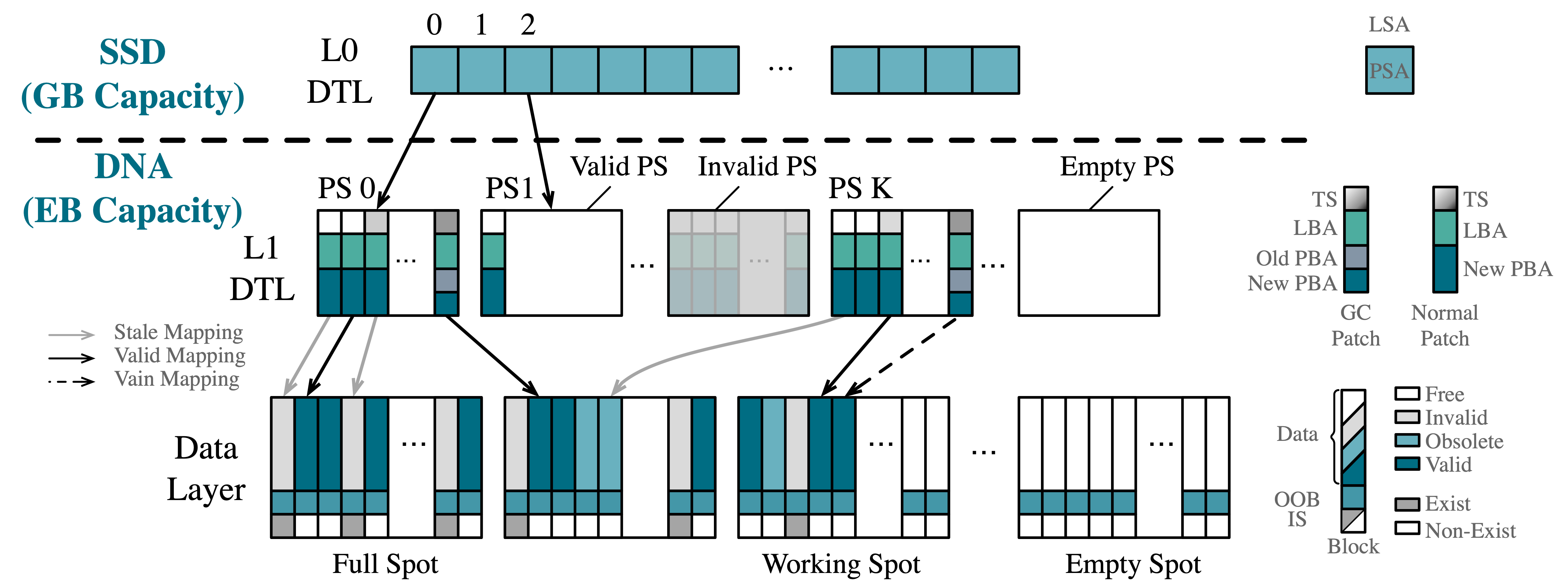
The rapid development of DNA synthesis and sequencing technologies is making the ultra-high-density storage medium DNA to meet the rising demand for enormous data storage. The block storage interface, which is massively employed in storage systems, is the critical abstraction to integrate DNA storage into silicon-based computer systems. In this paper, we explore building block devices on DNA and identify the challenges of petabyte-scale metadata management and high DNA access costs. We propose a holistic DNA block device design called LIQUID-STATE DRIVE to provide low-cost block access to exabyte-scale data with the help of small yet fast SSDs. We adopt the dual-layer translation table to leverage SSDs to decrease the metadata updating cost. We introduce symbiotic metadata and delayed invalidation to reduce the cost of garbage collection and block updating. Our evaluation demonstrates that in microbenchmarks and real-world traces, the write cost reduces up to seven orders of magnitude and 2, 927×, and the read cost reduces up to 6, 206×and 7×, respectively. We expect our exploration and experience in building DNA block devices to be useful in expediting the advancement of DNA storage and bridging the gap between information technology and biotechnology.